
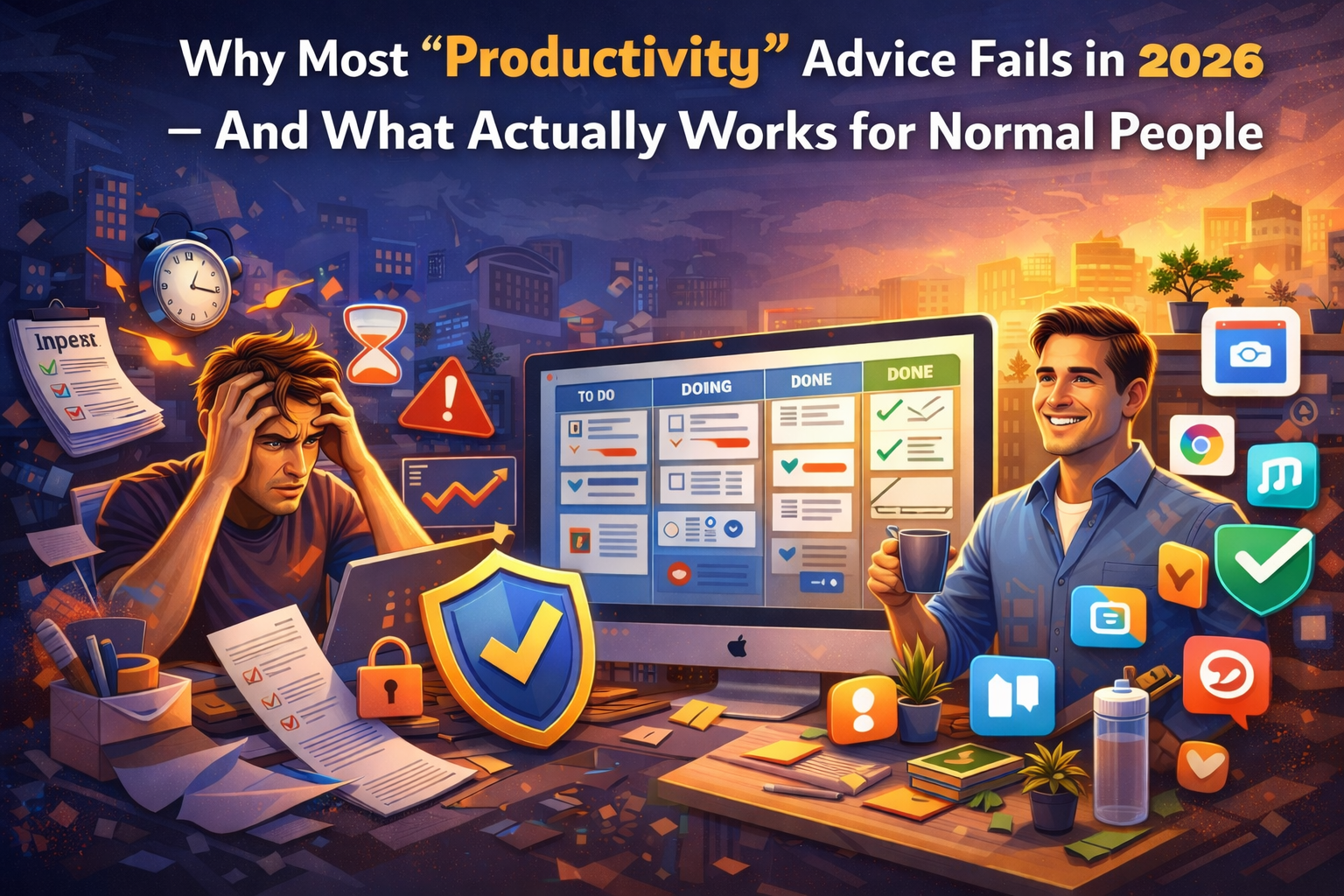
Why Most “Productivity” Advice Fails in 2026 – And What Actually Works for Normal People
I tried waking up at 5am for a month. It was terrible.
A few years back I got really into productivity content. You know the drill. Watched all the YouTube videos. Read the books. Bought the planner. I was convinced I just needed the right system and then everything would click.
The system everyone was pushing at the time was the early morning thing. Wake up at 5am. Meditate. Journal. Work out. Do your most important task before anyone else wakes up. Then the rest of the day is easy.
I tried it for a month. I was miserable.
I'm not a morning person. Never have been. My brain doesn't work right until about 9 or 10. So there I was at 5am, staring at my screen, trying to do deep work with a brain that was still half asleep. I wasn't getting more done. I was just tired.
And here's the thing nobody mentions. I had to go to bed at 9pm to get enough sleep. That meant missing dinner with friends. Missing evening time with my family. Missing my own wind-down hour where I actually feel most creative.
After that month I gave up. Felt like a failure for a while. Then I realized something. The problem wasn't me. The problem was that I was trying to fit myself into someone else's system.
Most productivity advice is written for people who don't have your life
Here's what I've noticed about the people who write productivity advice.
They're usually single. Or they have a partner who handles everything at home. They don't have young kids. They don't have aging parents who need help. They don't have a second job. They don't have chronic pain or anxiety or any of the stuff that makes days unpredictable.
Their life is clean. Their calendar is empty except for what they choose. Their energy is consistent.
That's not most people.
Most people have meetings that run long. Kids who get sick. Bosses who add one more thing at 4:45. Clients who change their mind. A body that feels different every day.
I have a friend who's a single mom with two kids and a full time job. She tried following a productivity system from some famous guy. It said to block four hours every morning for deep work. She laughed. She doesn't have four consecutive hours of anything. Ever.
That system wasn't wrong. It just wasn't for her.
The real problem isn't your willpower. It's your system.
Every productivity article tells you to just focus. Eliminate distractions. Try harder.
That's like telling a broke person to just make more money. It's not advice. It's judgment.
The truth is, willpower is a limited resource. You have a certain amount each day. Once it's gone, it's gone. No amount of motivation will bring it back.
So the answer isn't to try harder. The answer is to build systems that don't require willpower to maintain.
Think about it this way. You don't need willpower to brush your teeth. You just do it. It's automatic. It's built into your day. That's what a good system does. It makes the right thing the easy thing.
I used to spend willpower every single morning deciding what to work on. Should I do email first? Should I do the hard project? Should I check Slack? Every morning, a new decision. Every morning, a chance to make the wrong choice and waste my willpower before I even started.
Now I have a rule. First hour of the day is for one thing only. The thing I decided yesterday. No thinking required. No willpower spent. I just do it.
The one thing method. That's it.
Let me give you the simplest productivity system I know.
Every day, you pick one thing. Not three things. Not five things. One thing. The thing that actually moves the needle. The thing that matters most.
You write that thing down. You put it somewhere you can see it. And you do it first. Before email. Before Slack. Before anything else.
That's it.
I know it sounds too simple. But try it for a week. Most people are shocked by how much they get done. Because most people spend their days on small stuff that feels urgent but isn't important. The one thing method forces you to actually look at your priorities.
At the end of the day, you pick tomorrow's one thing. Write it on a sticky note. Put it on your monitor. When you sit down tomorrow, you know exactly what to do. No deciding. No waffling. Just doing.
I got this from a client actually. She's a graphic designer. She was drowning in small requests. Little changes. Quick fixes. She was working twelve hour days and never touching the big projects that actually paid the bills.
I asked her what one thing would make the biggest difference. She said finishing a proposal for a big potential client. So she put that on a sticky note. Did it first the next morning. Got the client. That one thing changed her whole month.
Free tools that don't become a second job
You don't need fancy software. You really don't.
I use three free things. Google Calendar for appointments and deadlines. Apple Notes for random thoughts and lists. Trello for projects that have more than a few steps.
That's it.
I tried Notion once. Spent two weeks building the perfect database. Never actually did any work in it. The tool became the project. That's a trap.
Same with Todoist. Same with Any.do. Same with all of them. They're fine. But they're not magic. A sticky note works just as well for most things.
Here's my rule. If you spend more time managing your to-do list than doing your to-do list, your system is broken.
The notification thing. I know I keep saying it. It's that important.
I sound like a broken record on this. But notifications are the single biggest productivity killer and nobody takes them seriously.
Every buzz, every banner, every little red dot pulls your attention away. Even if you don't look at it right away, it sits there. Studies show it takes about twenty three minutes to fully refocus after a distraction. Twenty three minutes.
So if you get ten notifications in a morning, that's basically your whole morning gone. Not because the notifications took time. Because the recovery took time.
Turn them off. All of them. Keep calls from your family. Keep calendar reminders. Everything else goes.
I turned off email notifications five years ago. Slack notifications four years ago. News notifications longer than I can remember. I check things when I check them. Nothing bad has ever happened.
Someone once asked me what if there's an emergency. I said they'll call me. Not email. Not Slack. Call. And if it's a real emergency, they will.
Your energy matters more than your time
Here's something most productivity advice ignores.
Time is not the only resource. Energy matters just as much.
An hour when you're tired and distracted is not the same as an hour when you're focused and fresh. Not even close.
So stop asking "how much time do I have?" Start asking "when am I most capable of doing hard things?"
For me, that's late morning. For my wife, it's right after lunch. For a friend of mine, it's 9pm after the kids are in bed. We're all different.
Figure out your energy pattern. Then put your one thing in that window. Everything else goes in the other windows.
I used to schedule my most important work for 3pm because that's when my calendar had a gap. But my brain is toast at 3pm. I was doing important work at my worst time. No wonder it took forever.
Now I do my one thing at 10am. My brain is good then. I get more done in one hour at 10am than I used to get done in three hours at 3pm.
The two hour block is real. But start with thirty minutes.
You hear a lot about deep work. Two hour blocks. No interruptions. Phone in another room.
That's great if you can do it. Most people can't. Meetings. Kids. Life.
So start smaller. Thirty minutes. That's it. Thirty minutes of focused work on your one thing. Phone face down. Email closed. Just thirty minutes.
Anyone can do thirty minutes. Even on a crazy day. Even when you're tired. Even when everything is falling apart.
Once thirty minutes becomes normal, try forty five. Then an hour. Then ninety minutes. Build up slowly.
I started with thirty minutes. Now I can do two hours most days. But on the days I can't, I still do thirty. Something is better than nothing.
The guilt is worse than the procrastination
Here's something nobody tells you.
The guilt you feel about not being productive is often worse for you than the procrastination itself.
You put something off. Then you feel bad about putting it off. Then you feel bad about feeling bad. Now you're not only behind on the work, you're also emotionally drained. So you put it off more. It's a spiral.
I used to do this all the time. I'd have a project I didn't want to do. So I'd avoid it. Then I'd feel guilty. Then I'd avoid it more because now it also felt shameful. By the time I finally did it, I had spent ten times more energy on guilt than the project would have taken.
Now I have a different rule. If I don't do something, I don't feel guilty. I just notice that I didn't do it. Then I ask myself why. Then I adjust.
Maybe I didn't do it because I was tired. So I rest. Maybe I didn't do it because it wasn't actually important. So I drop it. Maybe I didn't do it because it felt too big. So I break it into smaller pieces.
Guilt doesn't help. Guilt just makes everything worse.
What to do when you have too much to do
Sometimes the problem isn't productivity. The problem is you have too much on your plate.
No system will fix that. No app will help. No wakeup time will give you more hours.
When you have too much to do, you have two choices. Do less. Or get help.
Doing less means saying no to things. Or dropping things. Or deciding that some things just won't get done. That's hard. But it's real.
Getting help means hiring someone. Or asking for help. Or reassigning tasks. Also hard. Also real.
I had a period where I was working seven days a week and still falling behind. I kept trying new productivity systems. Nothing worked. Because the problem wasn't my system. The problem was I was doing the work of two people.
I finally hired someone to handle the stuff I hated and wasn't good at. Suddenly I had time. Not because I got more productive. Because I stopped doing things that didn't need to be done by me.
Productivity isn't about doing more. It's about doing what matters and ignoring the rest.
A weekly review that takes ten minutes
You don't need a fancy journaling practice. You don't need to track every hour. You need ten minutes at the end of each week.
Look at your calendar. What did you actually do?
Look at your one thing each day. Did you do it? If not, why not?
Look at next week. What's the one thing that matters most?
Write it down. Put it somewhere you'll see it on Monday morning.
That's it. Ten minutes. I do it on Friday afternoons when my brain is already done with deep work.
This weekly review is the secret sauce. Most people never stop to look at what they're actually doing. They just keep doing. The review forces you to look. And once you look, you can adjust.
The bottom line
You don't need a complicated system. You don't need to wake up at 5am. You don't need to spend money on apps.
You need one thing each day. You need to protect time for that thing. You need to turn off your notifications. You need to work with your energy, not against it. And you need to stop feeling guilty when things don't go perfectly.
That's it. That's what actually works for normal people in 2026.
Everything else is just noise.
Popular Tools
Recent Posts



.png)
